 InfoBuzzHub – Tech, Money, Lifestyle & Travel Insights
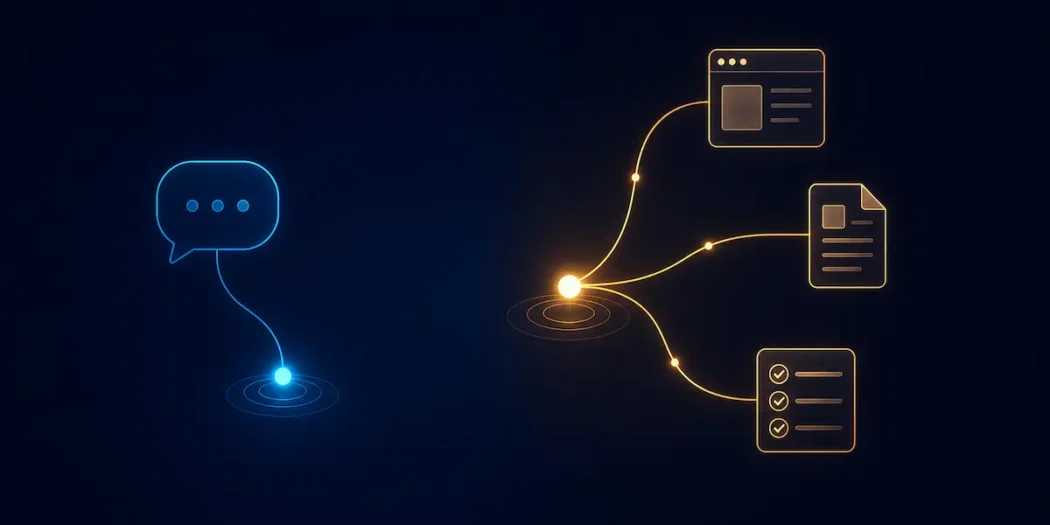
Quick Answer: The core difference is autonomy. A chatbot responds to one message at a time and stops until you send another one. An AI agent can plan a sequence of steps, use tools such as web search or a code environment, remember earlier steps, and keep working toward a goal with far less ongoing input from you. In short, a chatbot talks to you, while an AI agent can act on your behalf.
AI Agents vs Chatbots: Side by Side Comparison
| Dimension | Chatbot | AI Agent |
| Interaction style | Responds to one prompt, then waits | Plans and executes multiple steps toward a goal |
| Autonomy | Low, needs a new prompt for each step | Higher, can continue without constant input |
| Memory | Often limited to the current conversation | Can retain context across multiple steps or sessions |
| Tool use | Minimal or none in a basic chatbot | Can use tools like web browsers, code environments, or connected apps |
| Best for | Quick answers, simple Q&A, drafting text | Multi step tasks, research, coding, workflow automation |
| Oversight needed | Low, since it only responds when prompted | Higher, since more steps happen without direct approval at each stage |
| Example | Asking a chatbot to explain a concept | Asking an agent to research options, compare them, and compile a report |
Breaking Down the Key Differences
1. How Much They Do Without You
This is the single biggest difference. A chatbot is built for a question and answer exchange. You ask, it answers, and the conversation pauses. An AI agent is built to pursue a goal across multiple steps, which might include searching the web, comparing results, drafting something, checking its own work, and only returning to you once the task is further along or complete.
2. Memory and Context
Basic chatbots often work within the scope of a single conversation and do not carry context beyond it unless a system is specifically built to store it. AI agents are more likely to be paired with memory systems that let them track earlier steps in a task, which is necessary for multi step work to stay consistent from start to finish.
3. Tool Use
A chatbot on its own can only generate text. It cannot browse a live website, run code, or check a calendar unless it is connected to tools that let it do so. AI agents are specifically built around tool use, meaning they are given access to a defined set of actions, such as web search, file access, or an API connection, and they decide when and how to use them based on the task.
4. Decision Making
A chatbot follows the shape of the conversation you give it. An AI agent makes decisions about what to do next based on its goal and what it has learned from previous steps, which means its path through a task is not fully predetermined the way a chatbot’s single response is.
5. Risk and Oversight
Because a chatbot only responds when prompted, the risk of it doing something unintended is limited to the content of its response. An AI agent, since it can take multiple real actions in sequence, carries more risk if something goes wrong early in the process, which is why many agent systems include checkpoints where a person reviews or approves key actions before they happen.
When to Use a Chatbot
- You need a quick answer to a specific question
- You want help drafting or editing a piece of text
- You are having a single, self contained conversation that does not require ongoing actions
- You want a low complexity tool for simple, repeatable interactions like answering frequently asked questions
When to Use an AI Agent
- You need something to complete a task that involves multiple steps, such as researching a topic across several sources
- The task requires using external tools, such as browsing the web, working with files, or connecting to another app
- You want the system to continue working with less back and forth prompting from you
- The task benefits from the system remembering earlier steps as it works through later ones
Chatbots and Agents Are Not Always Separate
In practice, many modern AI products blur this line rather than being purely one or the other. A single conversational assistant might handle simple questions like a chatbot most of the time, then switch into agent like behavior when given a task that requires several steps, such as researching a topic and compiling the results. Claude and ChatGPT both work this way depending on how they’re used: a simple back and forth conversation functions like a chatbot, while asking either one to complete a multi step task with tools enabled shifts it closer to agent behavior.
This is part of why the terms get used inconsistently. The distinction is less about two separate categories of software and more about how much autonomy, memory, and tool access a given interaction actually has.
Common Misunderstandings
- Chatbots are becoming obsolete. Not accurate. Chatbots remain the right tool for simple, low risk interactions where speed and simplicity matter more than autonomy.
- Any AI that uses tools is automatically an agent. Not quite. What matters is whether the system is planning and executing a sequence of steps toward a goal, not just answering a single question with the help of one tool call.
- AI agents work without any human involvement. In practice, most reliable agent systems include human checkpoints for important or irreversible actions, rather than running with zero oversight.
FAQs
1. What is the main difference between an AI agent and a chatbot?
The main difference is autonomy. A chatbot responds to one prompt at a time and stops, while an AI agent can plan and carry out a sequence of steps toward a goal with less ongoing input.
2. Is ChatGPT a chatbot or an AI agent?
It depends on how it’s used. In a simple back and forth conversation, ChatGPT functions like a chatbot. When given tools and a multi step task, it can function more like an AI agent.
3. Can a chatbot become an AI agent?
A basic chatbot cannot become an agent on its own, but the same underlying language model can be combined with tools, memory, and planning ability to function as an agent instead of a simple conversational chatbot.
4. Which is better, an AI agent or a chatbot?
Neither is universally better. A chatbot is better for quick, simple interactions, while an AI agent is better suited for multi step tasks that require tool use and less ongoing input.
5. Do AI agents need more oversight than chatbots?
Generally yes, since an AI agent can take multiple real actions in sequence, which means an early mistake can affect later steps. Many agent systems include human checkpoints for important actions.
6. Are AI agents more expensive to use than chatbots?
Often yes, since AI agents may make multiple calls to an underlying model and use additional tools to complete a task, compared to a single response from a basic chatbot.
7. What is an example of an AI agent versus a chatbot doing the same task?
Asking a chatbot to explain how to research flight prices is a chatbot task. Asking an AI agent to actually search multiple sites, compare prices, and return the three best options is an agent task.
8. Do businesses need both chatbots and AI agents?
Many do. A common approach uses a chatbot to handle simple, frequent questions, while an AI agent handles more complex, multi step tasks that come up less often but require more depth.
Quick Questions People Also Ask
Q: What is the difference between an AI agent and a chatbot?
A: A chatbot responds to one prompt at a time and stops, while an AI agent can plan multiple steps, use tools, and continue working toward a goal with less ongoing input.
Q: Can chatbots use tools like AI agents do?
A: Basic chatbots generally cannot use tools on their own. Tool use is one of the defining features that separates an AI agent from a simple chatbot.
Q: Is an AI agent just a more advanced chatbot?
A: Not exactly. The difference is not just sophistication but structure, since an AI agent is built around planning, memory, and tool use to complete multi step tasks, rather than only generating a single response.
Q: When should I use a chatbot instead of an AI agent?
A: A chatbot is better suited for quick answers, simple questions, and self contained conversations that do not require ongoing actions.
Q: When should I use an AI agent instead of a chatbot?
A: An AI agent is better suited for tasks with multiple steps, tool use, or work that benefits from the system remembering earlier steps as it continues.
Q: Are AI agents replacing chatbots?
A: Not entirely. Chatbots remain useful for simple, low risk interactions, while AI agents are being adopted for more complex, multi step tasks alongside them, not necessarily instead of them.
Q: Do AI agents require more supervision than chatbots?
A: Generally yes, since agents take multiple real actions in sequence, which increases the importance of checkpoints and oversight compared to a chatbot that only responds when prompted.


